*Oil prices plunged nearly 5% after the U.S.–Iran framework agreement eased fears of prolonged supply disruptions through the Strait of Hormuz.
*Expectations of renewed crude exports and improved shipping access significantly reduced the geopolitical risk premium in oil markets.
*Brent and WTI fell to their lowest levels since early March as traders priced in the prospect of increased global supply.
Market Summary:
Oil prices experienced one of their sharpest declines in months after the United States and Iran announced a framework agreement aimed at ending the conflict and reopening the Strait of Hormuz, a critical shipping lane that normally handles around one-fifth of global oil supply. The announcement erased much of the geopolitical risk premium that had built up during the conflict, with Brent crude falling nearly 5% to around US$83 per barrel and WTI dropping toward US$80–81, their lowest levels since early March. Markets interpreted the agreement as a sign that disrupted exports could gradually resume, easing concerns over global supply shortages and reducing inflationary pressures worldwide.
Despite the initial selloff, oil prices recovered modestly as traders reassessed the timeline for normalization. The agreement remains preliminary, with a formal signing expected later this week and several key issues including Iran’s nuclear program and the mechanics of reopening shipping lanes still unresolved. Shipping organizations have warned that security conditions in the Persian Gulf remain uncertain, while analysts note that clearing mines, restoring marine insurance, repositioning vessels, and restarting damaged infrastructure could take weeks or even months. Estimates suggest nearly 14 million barrels per day of production remain offline, meaning physical supply is unlikely to return immediately even if diplomatic progress continues.
Fundamentally, the medium-term outlook for crude remains balanced between easing geopolitical tensions and lingering structural tightness. Iran has already lowered its official selling price for Asian buyers, reflecting expectations of improving exports, while institutions such as Citi have reduced their oil price forecasts on the assumption that Strait of Hormuz flows will normalize. However, strategic petroleum reserves in major economies remain historically low, with U.S. emergency stockpiles at their weakest level since 1983, and industry experts caution that replenishing inventories and restoring production capacity could support prices over the longer term. As a result, while the peace framework creates clear near-term downside pressure for oil, implementation risks and logistical constraints are likely to keep volatility elevated and prevent a rapid return to pre-conflict market conditions.
Technical Analysis
Crude Oil, H4:
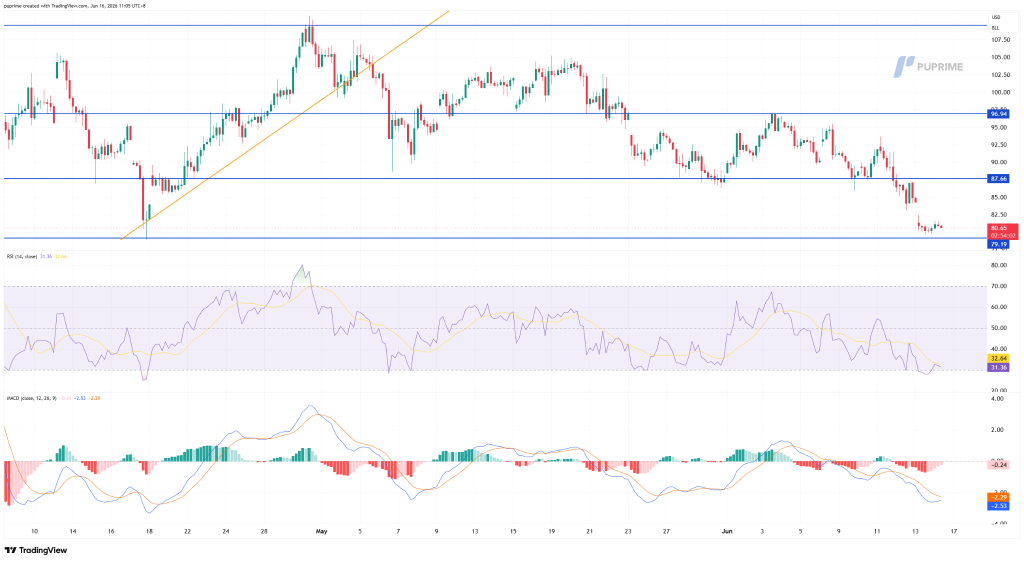
Crude Oil remains under significant bearish pressure after extending its decline and breaking below several key support levels over recent weeks. Price has established a clear sequence of lower highs and lower lows since peaking above the 107.50 region, reflecting persistent selling interest and confirming the strength of the prevailing downtrend. The recent breakdown below the major support zone at 87.65 further reinforced bearish momentum, allowing sellers to drive prices toward the critical support area near 79.20, where the market is currently attempting to stabilize.
Despite the recent pause in selling activity, the broader technical structure remains negative. The inability of crude oil to reclaim the former support level at 87.65 suggests that previous support has now transitioned into resistance, while the continued trading below the descending trend structure highlights the lack of meaningful bullish participation. Although price is showing signs of short-term consolidation above 79.20, buyers have yet to demonstrate sufficient strength to challenge the broader bearish trend.
Momentum indicators continue to favor the downside outlook. The Relative Strength Index (RSI) remains below the neutral 50 level and is currently holding near 31, indicating weak market sentiment and lingering bearish momentum, although oversold conditions may limit immediate downside acceleration. Meanwhile, the Moving Average Convergence Divergence (MACD) remains firmly in negative territory, with both signal lines trending lower and the histogram continuing to reflect dominant selling pressure, suggesting that bearish momentum remains intact despite the recent stabilization.
Resistance Levels: 87.65, 96.95
Support Levels: 79.20, 67.95
Start trading with an edge today
Trade forex, indices, metal, and more at industry-low spreads and lightning-fast execution.
Start trading with deposits as low as $50 on our standard accounts.
Get access to 24/7 support.
Access hundreds of instruments, free educational tools, and some of the best promotions around.
Important Notice: Please note the Website is intended for individuals residing in jurisdictions where accessing the Website is permitted by law.
Please note that PU Prime and its affiliated entities are neither established nor operating in your home jurisdiction.
By clicking the "Acknowledge" button, you confirm that you are entering this website solely on your own initiative and not as a result of any specific marketing outreach. You wish to obtain information from this website which is provided on a reverse solicitation basis in accordance with the laws of your home jurisdiction.
Please note the Website is intended for individuals residing in jurisdictions where accessing the Website is permitted by law.
Please note that PU Prime and its affiliated entities are neither established nor operating in your home jurisdiction.
By clicking the "Acknowledge" button, you confirm that you are entering this website solely based on your initiative and not as a result of any specific marketing outreach. You wish to obtain information from this website which is provided on reverse solicitation in accordance with the laws of your home jurisdiction.
Ten en cuenta que el sitio web está destinado a personas que residen en jurisdicciones donde el acceso al sitio web está permitido por la ley.
Ten en cuenta que PU Prime y sus entidades afiliadas no están establecidas ni operan en tu jurisdicción de origen.
Al hacer clic en el botón "Aceptar", confirmas que estás ingresando a este sitio web por tu propia iniciativa y no como resultado de ningún esfuerzo de marketing específico. Deseas obtener información de este sitio web que se proporciona mediante solicitud inversa de acuerdo con las leyes de tu jurisdicción de origen.