*Oil prices remain sensitive to developments in the Strait of Hormuz as markets balance geopolitical risks against improving supply.
*Renewed tensions following Iran’s cargo ship attack have revived supply disruption concerns but failed to trigger a sustained rally.
*Recovering tanker traffic and stronger crude export expectations continue to reduce the geopolitical risk premium.
Market Summary:
Oil markets remain highly sensitive to developments surrounding the Strait of Hormuz, balancing improving supply conditions against renewed geopolitical risks. Earlier optimism surrounding the US-Iran memorandum of understanding had driven Brent and WTI prices back toward pre-conflict levels as commercial shipping gradually resumed through the waterway. Vessel traffic has steadily increased, tanker movements have accelerated, and expectations of improving crude exports have significantly reduced the geopolitical risk premium that previously supported prices.
However, renewed tensions have complicated this narrative. Reports that Iran attacked a Singapore-flagged cargo vessel attempting to transit the Strait of Hormuz have raised fresh concerns about the durability of the recent agreement. Following the incident, the International Maritime Organization suspended its voluntary maritime escort operations, while Iranian authorities warned that vessels travelling outside designated shipping routes would not be guaranteed security. Separately, Iran has reportedly proposed introducing maritime service fees for vessels using the Strait after the temporary 60-day agreement expires, estimating potential annual revenues of up to US$40 billion. Although US officials have opposed the proposal, these developments highlight that long-term security and navigation through the world’s most strategically important energy corridor remain unresolved.
Despite the renewed geopolitical concerns, oil prices have struggled to sustain gains. The market continues to focus on recovering supply, increased tanker traffic, improving export activity, and expectations that Gulf producers may continue increasing production. Several analysts also note that Brent’s futures curve has shifted toward contango, reflecting improving near-term supply conditions and expectations of a more balanced market later this year. Additional uncertainty surrounding Venezuelan production following recent earthquakes has offered only limited support.
Looking ahead, traders are likely to remain highly responsive to geopolitical headlines. Any further attacks on commercial shipping or deterioration in US-Iran negotiations could quickly restore a larger geopolitical premium. However, as long as tanker traffic continues recovering and crude exports remain uninterrupted, supply fundamentals are likely to cap significant upside despite elevated regional tensions.
Technical Analysis
Crude Oil, H4:
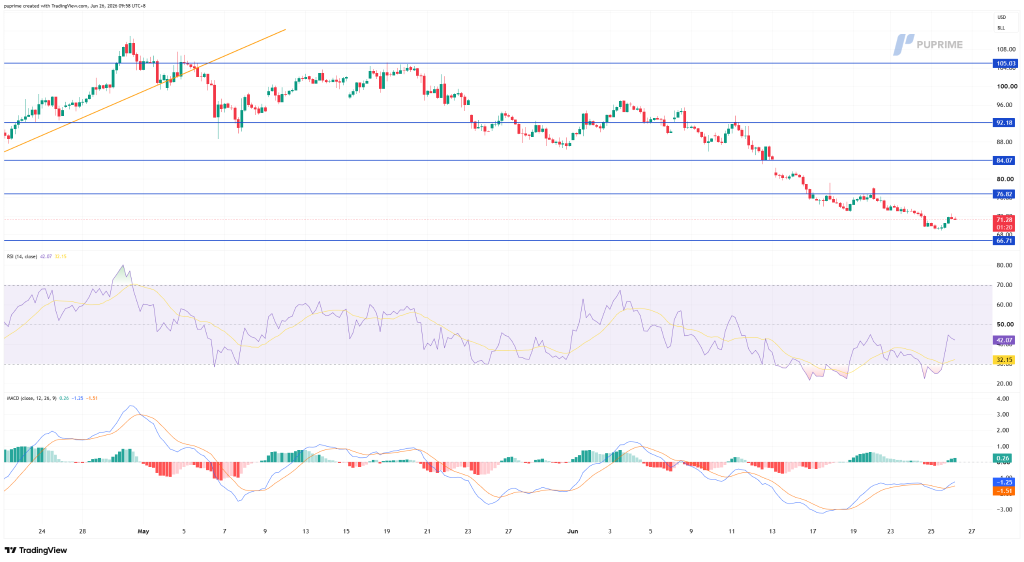
Crude oil remains under bearish pressure despite staging a modest rebound after finding support near the 66.70 level. Following the decisive breakdown below the former support zones at 84.05 and 76.80, selling momentum accelerated sharply, reinforcing the prevailing downtrend. Although prices have recovered modestly from recent lows, the rebound remains corrective in nature, with the broader market structure continuing to favor the downside.
The inability to reclaim the broken support level around 76.80 suggests that sellers remain firmly in control, while the recent bounce from 66.70 reflects only a temporary recovery following an extended decline. As long as price continues to trade below the former support zones, previous support is likely to act as resistance, limiting the scope for a more meaningful recovery.
Momentum indicators are showing early signs of stabilization but remain mixed overall. The Relative Strength Index (RSI) has rebounded above the 40 level after recovering from near-oversold territory, indicating that selling pressure has eased while buying interest is gradually improving. Meanwhile, the Moving Average Convergence Divergence (MACD) has produced a bullish crossover below the zero line, with the histogram turning positive, suggesting that downside momentum is fading. However, the MACD remains in negative territory, implying that the broader bearish trend has yet to reverse.
Resistance Levels: 76.80, 84.05
Support Levels: 66.70, 57.85
Start trading with an edge today
Trade forex, indices, metal, and more at industry-low spreads and lightning-fast execution.
Start trading with deposits as low as $50 on our standard accounts.
Get access to 24/7 support.
Access hundreds of instruments, free educational tools, and some of the best promotions around.
Important Notice: Please note the Website is intended for individuals residing in jurisdictions where accessing the Website is permitted by law.
Please note that PU Prime and its affiliated entities are neither established nor operating in your home jurisdiction.
By clicking the "Acknowledge" button, you confirm that you are entering this website solely on your own initiative and not as a result of any specific marketing outreach. You wish to obtain information from this website which is provided on a reverse solicitation basis in accordance with the laws of your home jurisdiction.
Please note the Website is intended for individuals residing in jurisdictions where accessing the Website is permitted by law.
Please note that PU Prime and its affiliated entities are neither established nor operating in your home jurisdiction.
By clicking the "Acknowledge" button, you confirm that you are entering this website solely based on your initiative and not as a result of any specific marketing outreach. You wish to obtain information from this website which is provided on reverse solicitation in accordance with the laws of your home jurisdiction.
Ten en cuenta que el sitio web está destinado a personas que residen en jurisdicciones donde el acceso al sitio web está permitido por la ley.
Ten en cuenta que PU Prime y sus entidades afiliadas no están establecidas ni operan en tu jurisdicción de origen.
Al hacer clic en el botón "Aceptar", confirmas que estás ingresando a este sitio web por tu propia iniciativa y no como resultado de ningún esfuerzo de marketing específico. Deseas obtener información de este sitio web que se proporciona mediante solicitud inversa de acuerdo con las leyes de tu jurisdicción de origen.