*The US dollar remains supported as ongoing uncertainty surrounding US-Iran negotiations continues to generate periodic safe-haven demand.
*Renewed tensions involving Israel, Hezbollah, and potential shipping risks near the Strait of Hormuz have reduced confidence in a quick diplomatic resolution, benefiting the greenback.
*Federal Reserve officials continue to warn that elevated energy prices could keep inflation persistent, reinforcing higher-for-longer interest rate expectations.
Market Summary:
The US dollar entered the new week on relatively stable footing after posting a modest decline last week, as investors continued to assess conflicting developments surrounding the ongoing US-Iran negotiations. Earlier optimism that Washington and Tehran were nearing a 60-day ceasefire extension agreement, potentially allowing the reopening of the Strait of Hormuz, initially reduced safe-haven demand for the greenback and pushed the Dollar Index back toward the 99.00 area. Reports suggested that both sides had exchanged draft proposals and amendments over the weekend, fueling hopes that disruptions to global energy supplies could eventually ease. However, uncertainty remains elevated after President Trump reportedly requested revisions to key parts of the agreement, including issues surrounding uranium enrichment and guarantees regarding maritime security in the Strait of Hormuz.
At the same time, geopolitical tensions have shown signs of re-escalation. Israel ordered troops deeper into Lebanon over the weekend in response to renewed Hezbollah activity, while reports emerged that Iranian-linked forces may have continued placing mines near strategic shipping routes. These developments helped reverse some of the market’s earlier optimism and contributed to renewed demand for defensive assets. The dollar benefited from this shift in sentiment as traders reassessed the likelihood of a swift and lasting resolution to the Middle East conflict.
Beyond geopolitics, monetary policy expectations continue to provide a significant source of support for the dollar. Recent comments from Federal Reserve officials, including Vice Chair Michelle Bowman and Philadelphia Fed President Anna Paulson, reinforced concerns that elevated energy prices could prolong inflationary pressures and potentially require tighter policy for longer. Markets that had previously anticipated rate cuts are increasingly considering the possibility that the Fed’s next move could actually be a rate hike if inflation remains persistent. This repricing has helped maintain elevated Treasury yields and limited downside pressure on the greenback.
Investors are now shifting their focus toward this week’s key economic releases, particularly the US Non-Farm Payrolls report. Consensus expectations point to approximately 85,000 new jobs and an unemployment rate near 4.3%. A stronger-than-expected labor market could reinforce higher-for-longer rate expectations and provide fresh support for the dollar, while weaker employment data may revive discussions about eventual policy easing. As a result, the dollar remains caught between competing forces of geopolitical uncertainty and evolving monetary policy expectations.
Technical Analysis
Dollar Index, H4
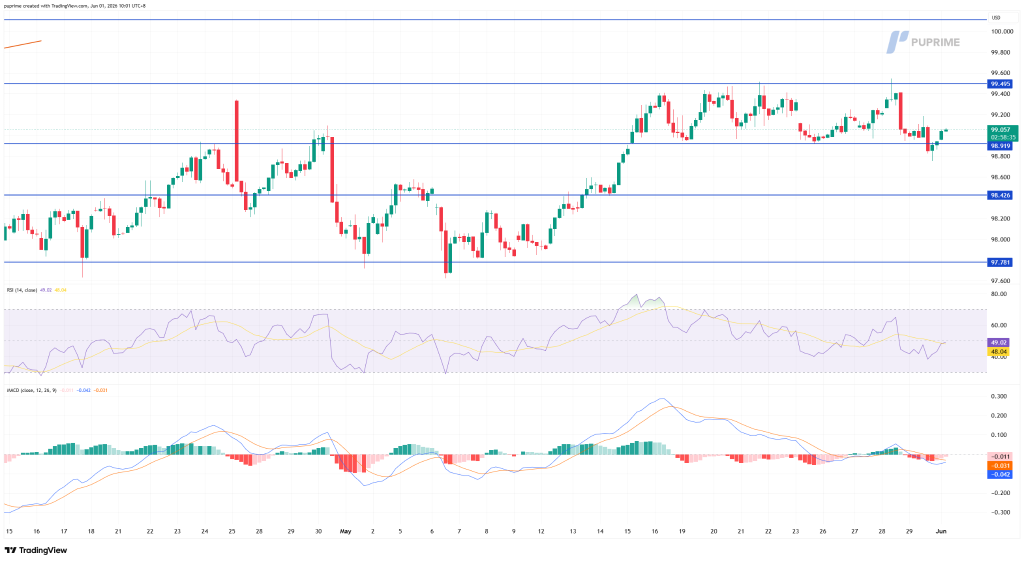
The U.S. Dollar Index (DXY) remains trapped within a broad consolidation phase after failing to establish a decisive breakout above the key 99.50 resistance zone.Price action is currently fluctuating between the 98.90 support and 99.50 resistance levels, reflecting a period of market indecision. The recent rebound from support suggests that buyers remain active at lower levels, but the inability to generate a sustained move above resistance highlights a lack of conviction from the bullish side. This ongoing range-bound behavior indicates that traders are waiting for a stronger catalyst before committing to the next directional move.
From a momentum perspective, technical indicators remain relatively neutral. RSI is hovering around the 50 level, signaling balanced market conditions with neither buyers nor sellers holding a clear advantage. Meanwhile, the MACD remains below the zero line and is attempting to stabilize after a recent bearish crossover. Histogram bars have begun to flatten, suggesting that downside momentum is losing strength, although a meaningful bullish reversal signal has yet to emerge.
Resistance Levels: 99.50, 100.10
Support Levels: 98.90, 98.40
Start trading with an edge today
Trade forex, indices, metal, and more at industry-low spreads and lightning-fast execution.
Start trading with deposits as low as $50 on our standard accounts.
Get access to 24/7 support.
Access hundreds of instruments, free educational tools, and some of the best promotions around.
Important Notice: Please note the Website is intended for individuals residing in jurisdictions where accessing the Website is permitted by law.
Please note that PU Prime and its affiliated entities are neither established nor operating in your home jurisdiction.
By clicking the "Acknowledge" button, you confirm that you are entering this website solely on your own initiative and not as a result of any specific marketing outreach. You wish to obtain information from this website which is provided on a reverse solicitation basis in accordance with the laws of your home jurisdiction.
Please note the Website is intended for individuals residing in jurisdictions where accessing the Website is permitted by law.
Please note that PU Prime and its affiliated entities are neither established nor operating in your home jurisdiction.
By clicking the "Acknowledge" button, you confirm that you are entering this website solely based on your initiative and not as a result of any specific marketing outreach. You wish to obtain information from this website which is provided on reverse solicitation in accordance with the laws of your home jurisdiction.
Ten en cuenta que el sitio web está destinado a personas que residen en jurisdicciones donde el acceso al sitio web está permitido por la ley.
Ten en cuenta que PU Prime y sus entidades afiliadas no están establecidas ni operan en tu jurisdicción de origen.
Al hacer clic en el botón "Aceptar", confirmas que estás ingresando a este sitio web por tu propia iniciativa y no como resultado de ningún esfuerzo de marketing específico. Deseas obtener información de este sitio web que se proporciona mediante solicitud inversa de acuerdo con las leyes de tu jurisdicción de origen.