*Oil has become the central macro driver influencing inflation, Fed policy, and overall market sentiment
*U.S.-Iran tensions and Strait of Hormuz uncertainty continue driving extreme oil volatility
*Markets remain highly headline-sensitive as traders react to every diplomatic and military update
Market Summary:
Oil has become the most important macro asset in global markets because it now directly influences inflation expectations, Federal Reserve policy, bond yields, and overall market sentiment. The main driver behind recent volatility is the ongoing U.S.-Iran conflict and uncertainty surrounding the Strait of Hormuz, which handles roughly 20% of global seaborne oil trade.
Earlier this week, oil prices fell sharply after reports suggested progress toward a possible U.S.-Iran agreement and a reopening of Hormuz. Markets believed a diplomatic breakthrough could restore supply flows, reduce inflation pressure, and lower geopolitical risk premiums. This initially supported equities while weakening gold.However, sentiment quickly reversed after fresh U.S. strikes in Iran and reports that negotiations remain difficult. President Trump stated he was “not satisfied” with the talks and warned the U.S. would not accept a weak agreement. Iran also remains resistant to giving up authority over Hormuz or making major concessions. As a result, Brent crude rebounded toward the US$95–$96 range while WTI climbed back above US$90.
The market is now caught between two major scenarios. A successful agreement could send oil sharply lower toward the US$80s, while failed negotiations or further military escalation could push prices above US$100 very quickly. Because of this, oil has become extremely headline-sensitive.
Institutional analysts are increasingly warning that elevated oil prices are creating broader inflation risks across the global economy. Higher fuel and transportation costs are feeding into consumer prices, making central banks more cautious about cutting rates. This has pushed Treasury yields higher and increased fears that the Federal Reserve may keep policy restrictive for longer. Supply conditions also remain tight. Recent API inventory data showed another large decline in U.S. crude stockpiles, marking the sixth consecutive weekly drawdown. Analysts believe current strategic reserve releases and weaker Chinese imports have temporarily softened the impact of supply disruptions, but this support may fade later in the year.
Markets are now watching every development related to the U.S.-Iran negotiations, military activity near Hormuz, and upcoming U.S. inflation data. Oil is no longer trading only on supply and demand fundamentals but now the central driver of inflation expectations, Fed policy, and broader global market direction.
Technical Analysis
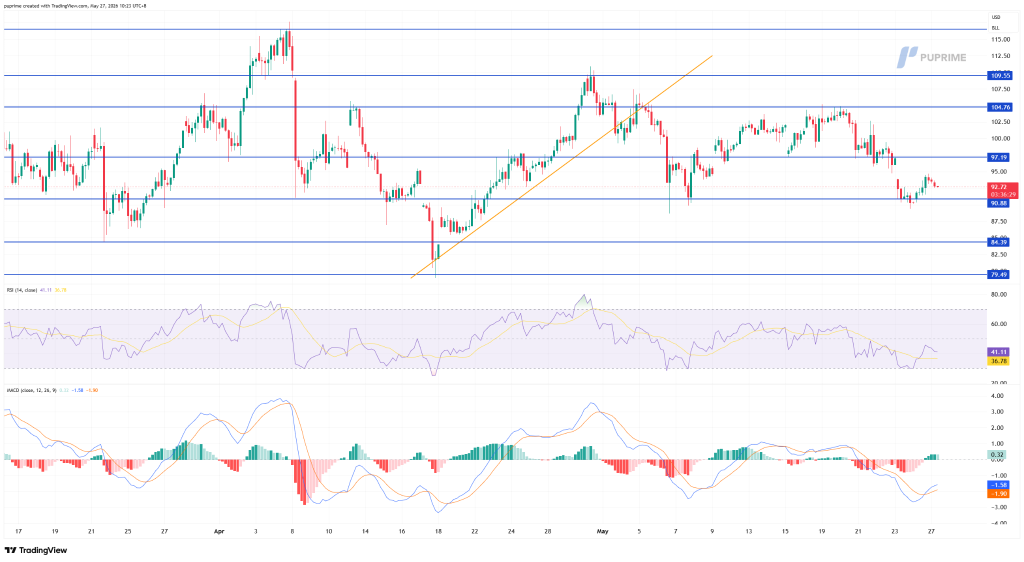
Crude Oil, H4:
Crude oil remains under pressure after failing to sustain its recent rebound attempt, with price continuing to trade below the key 97.20 resistance region. Recent price action shows WTI attempting to stabilize near the 90.40 support level following a sharp decline, although the broader structure continues to reflect lower highs and persistent bearish momentum after the breakdown below the previous ascending trendline.
Momentum indicators are beginning to show early signs of stabilization after the recent selloff. The Relative Strength Index (RSI) has rebounded modestly from near-oversold territory, suggesting that downside momentum may be easing slightly in the short term. Meanwhile, the MACD remains in negative territory, although the histogram has started to flatten while the MACD lines attempt to stabilize, reflecting a potential slowdown in selling pressure.
Overall, crude oil appears to be entering a temporary consolidation phase following its recent decline, although stronger bullish confirmation would still be required before a broader recovery structure can develop. A sustained hold above the 90.40 support region may help stabilize sentiment, while a break below this level could expose deeper downside risks toward the 84.40 support area.
Resistance Levels: 97.20, 104.75
Support Levels: 90.40, 84.40
Start trading with an edge today
Trade forex, indices, metal, and more at industry-low spreads and lightning-fast execution.
Start trading with deposits as low as $50 on our standard accounts.
Get access to 24/7 support.
Access hundreds of instruments, free educational tools, and some of the best promotions around.
Important Notice: Please note the Website is intended for individuals residing in jurisdictions where accessing the Website is permitted by law.
Please note that PU Prime and its affiliated entities are neither established nor operating in your home jurisdiction.
By clicking the "Acknowledge" button, you confirm that you are entering this website solely on your own initiative and not as a result of any specific marketing outreach. You wish to obtain information from this website which is provided on a reverse solicitation basis in accordance with the laws of your home jurisdiction.
Please note the Website is intended for individuals residing in jurisdictions where accessing the Website is permitted by law.
Please note that PU Prime and its affiliated entities are neither established nor operating in your home jurisdiction.
By clicking the "Acknowledge" button, you confirm that you are entering this website solely based on your initiative and not as a result of any specific marketing outreach. You wish to obtain information from this website which is provided on reverse solicitation in accordance with the laws of your home jurisdiction.
Ten en cuenta que el sitio web está destinado a personas que residen en jurisdicciones donde el acceso al sitio web está permitido por la ley.
Ten en cuenta que PU Prime y sus entidades afiliadas no están establecidas ni operan en tu jurisdicción de origen.
Al hacer clic en el botón "Aceptar", confirmas que estás ingresando a este sitio web por tu propia iniciativa y no como resultado de ningún esfuerzo de marketing específico. Deseas obtener información de este sitio web que se proporciona mediante solicitud inversa de acuerdo con las leyes de tu jurisdicción de origen.