Work out the margin you need to open a trade. But this calculator does something others do not: it shows your safety buffer — how far the price can move against you before a margin call or stop-out.
$
Required margin to open this trade
$470.00
Position value
$235,000
Free margin left
$1,530
Margin level
426%
Your Safety Buffer
This is the part no other calculator shows you. It answers the question every trader actually worries about: how far can the market move against me before I get a margin call or get stopped out?
For illustration only. Uses indicative prices and PU Prime’s standard 100% margin-call and 50% stop-out levels; your live values may differ. Leverage increases both profits and losses. Trading CFDs carries a high risk of rapid loss. PU Prime is regulated by the FSA (Seychelles, SD050), FSCA (South Africa, FSP 52218), FSC (Mauritius, GB23202672), and CMA (UAE, 20200000388).
Use the free calculator above to find your required margin for any pair, gold, or index.
Then read on, because this calculator does something no other one does: it tells you exactly how far the market can move against you before you get a margin call or a stop-out.
Key Overviews
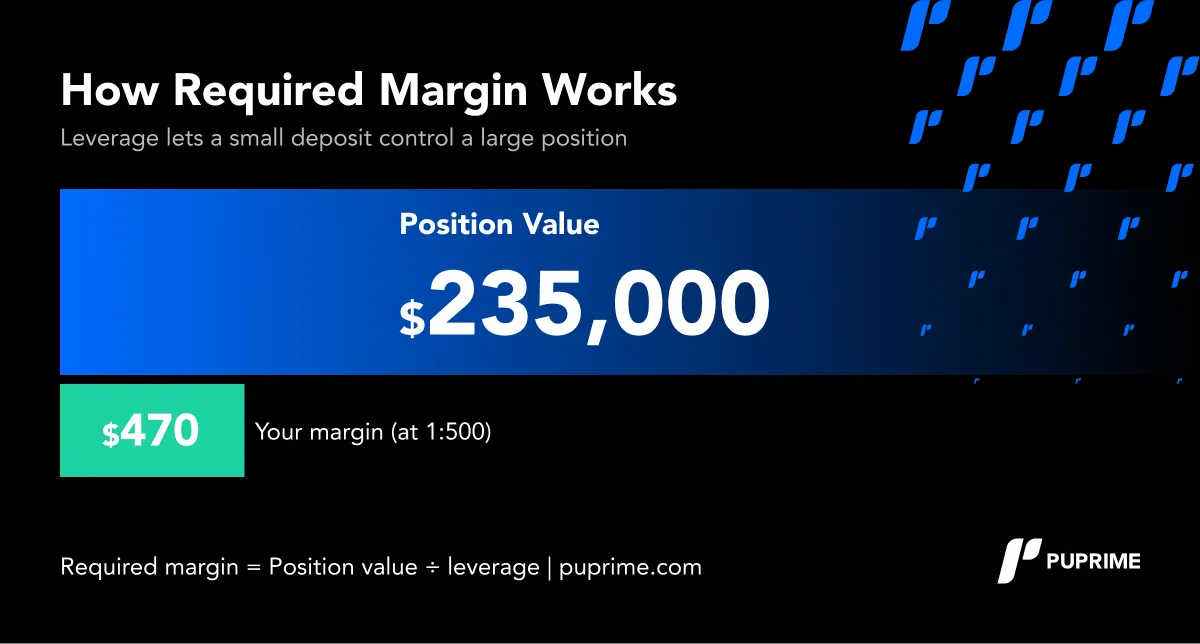
Required margin = position value ÷ leverage. A $235,000 position at 1:500 needs $470.
Margin is not a fee. It is a deposit held aside while your trade is open, and returned when you close.
Your margin level (equity ÷ used margin) is the number that decides whether you stay in the trade.
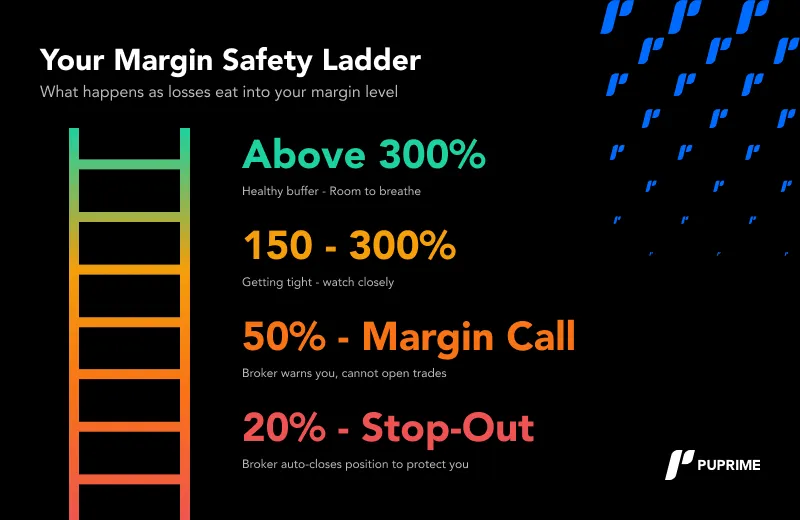
At 100% margin level, you get a margin call. At 50%, PU Prime closes your trades (stop-out) to limit losses.
The safety buffer is how much your account can lose before those levels are hit — the number that actually matters.
Higher leverage means less required margin but a thinner safety buffer. The two are linked.
What Is Margin in Forex?
Margin is the amount of money your broker sets aside from your account to keep a leveraged trade open.
It is not a cost or a fee — it is more like a security deposit. When you close the trade, the margin is released back to you.
Because forex is traded with leverage, you do not need the full value of a position to open it.
A leverage of 1:500 means you only need to put up 1/500 of the position’s value.
That is why a small account can control a large trade.
The trade-off is risk. The same leverage that lets you open a large position with a small deposit also magnifies losses.
This is why understanding your margin and leverage properly is one of the most important things a new trader can learn.
How to Calculate Required Margin
The formula is simple: Required margin = (position value) ÷ (leverage).
To find the position value, multiply the current price by the contract size by your trade size in lots.
For a standard lot of EUR/USD at 1.0850, that is 1.0850 × 100,000 × 1 = $108,500. At 1:500 leverage, the required margin is $108,500 ÷ 500 = $217.
Gold works a little differently because the contract size is 100 ounces. One lot of gold at $2,350 is a $235,000 position, so at 1:500 the margin is $470.
The calculator above handles all of this automatically — you just pick your instrument, lot size, and leverage.
The Part Other Calculators Skip: Your Safety Buffer
Here is the question every trader actually worries about, and the one most calculators ignore: how far can the price move against me before I lose this trade?
This is where the margin level comes in.
Your margin level is your account equity divided by your margin, expressed as a percentage.
As a losing trade erodes your equity, your margin falls.
Two things happen on the way down.
At 50% margin level, you hit a margin call. Your broker warns you that your account is running low, and you cannot open new trades.
At 20% margin level on PU Prime, you hit the stop-out level, and the broker automatically closes your positions to stop your account from going negative.
The safety buffer is the dollar amount your account can lose before these levels are reached.
The calculator above shows you both numbers: how much loss it takes you to a margin call, and how much it takes you to a stop-out.
If those numbers look small compared to a normal price swing in your instrument, your position is too big — and the calculator will tell you so directly.
Why Higher Leverage Shrinks Your Buffer
It is tempting to use the highest leverage available because it lowers your required margin. But there is a hidden cost: leverage and your safety buffer are linked.
With higher leverage, you tie up less margin, which sounds good. But it also tempts traders to open much larger positions.
A larger position loses money faster when the market moves against it, which eats your equity — and your margin level — more quickly. The result is a thinner buffer and a faster route to a stop-out.
The disciplined approach is to use leverage to free up capital, not to maximize position size.
Keep your position sized to your account, set a stop-loss on every trade, and use the calculator to check that your buffer is comfortable before you enter.
How to Use the Margin Calculator
Choose your instrument. Forex pair, gold, or index. The calculator automatically uses the correct contract size.
Enter your trade size in lots and your leverage. The calculator shows your required margin instantly.
Enter your account balance. This unlocks the safety buffer: your free margin, margin level, and how far you are from a margin call and stop-out.
Read the verdict. Green means a healthy buffer. Amber means it is tight. Red means the position is too large for your account — reduce your lot size or leverage.
Frequently Asked Questions
What is a forex margin calculator?
A forex margin calculator works out how much margin you need to open a trade, based on the instrument, trade size, and leverage. A good one also shows your safety buffer: how far the market can move against you before a margin call or stop-out.
How do you calculate therequired margin?
The required margin equals the position value divided by your leverage. The position value is the price multiplied by the contract size multiplied by your lot size. For example, a $108,500 EUR/USD position at 1:500 leverage requires $217 in margin.
What is the difference between margin and free margin?
Used margin is the amount tied up in your open trades. Free margin is the equity you have left over that can absorb losses or open new trades. Free margin equals your equity minus your used margin.
What is a margin call?
A margin call happens when your margin level falls to 50%, meaning your equity has dropped to the same value as your used margin. Your broker warns you, and you cannot open new positions. If losses continue, a stop-out will be triggered.
What is the stop-out level on PU Prime?
PU Prime’s stop-out level is 20%. If your margin level falls to 50%, the platform automatically closes your open positions, starting with the largest losing one, to protect your account from going negative. The margin-call warning comes earlier, at 50%.
How do you calculate leverage?
Leverage is the ratio of your position value to the margin required. If a $100,000 position needs $1,000 of margin, your leverage is 100:1. Put another way, leverage equals position value divided by the margin you put up.
Does higher leverage mean more risk?
Yes. Higher leverage lowers your required margin, but it tempts traders into larger positions and shrinks the safety buffer before a stop-out. The leverage itself is a tool; the risk comes from oversizing positions because it is available.
Start trading with an edge today
Trade forex, indices, metal, and more at industry-low spreads and lightning-fast execution.
Start trading with deposits as low as $50 on our standard accounts.
Get access to 24/7 support.
Access hundreds of instruments, free educational tools, and some of the best promotions around.
Important Notice: Please note the Website is intended for individuals residing in jurisdictions where accessing the Website is permitted by law.
Please note that PU Prime and its affiliated entities are neither established nor operating in your home jurisdiction.
By clicking the "Acknowledge" button, you confirm that you are entering this website solely on your own initiative and not as a result of any specific marketing outreach. You wish to obtain information from this website which is provided on a reverse solicitation basis in accordance with the laws of your home jurisdiction.
Please note the Website is intended for individuals residing in jurisdictions where accessing the Website is permitted by law.
Please note that PU Prime and its affiliated entities are neither established nor operating in your home jurisdiction.
By clicking the "Acknowledge" button, you confirm that you are entering this website solely based on your initiative and not as a result of any specific marketing outreach. You wish to obtain information from this website which is provided on reverse solicitation in accordance with the laws of your home jurisdiction.
Ten en cuenta que el sitio web está destinado a personas que residen en jurisdicciones donde el acceso al sitio web está permitido por la ley.
Ten en cuenta que PU Prime y sus entidades afiliadas no están establecidas ni operan en tu jurisdicción de origen.
Al hacer clic en el botón "Aceptar", confirmas que estás ingresando a este sitio web por tu propia iniciativa y no como resultado de ningún esfuerzo de marketing específico. Deseas obtener información de este sitio web que se proporciona mediante solicitud inversa de acuerdo con las leyes de tu jurisdicción de origen.